Secure MBBS in Georgia, Uzbekistan, and Kyrgyzstan for the 2026 Cohort
Let's analyze the 2026 Opportunity Gap in Indian medical education, a systemic disconnect where high-potential NEET aspirants are sidelined by an artificial ceiling on seat capacity and domestic costs reaching ₹1 Crore. Explore the rich academic heritage and globally recognized MBBS programs offered in destinations across Europe, like Georgia, Uzbekistan, and Kyrgyzstan, presenting unparalleled leverage to aspirants seeking a career in medicine. It reframes international education not as a secondary choice, but as a strategic evolution in the democratization of specialized knowledge.
Prajim Mannemplavan
4/3/20264 min read
The global landscape of medical education in 2026 is defined by a critical tension. This tension exists between the localized scarcity of academic resources and the transnational mobility of professional aspirations. Within the South Asian context, and particularly in India, the structural constraints of the domestic medical seat allocation system have created what is professionally identified as the Opportunity Gap. This gap represents a systemic disconnect where thousands of highly qualified students are precluded from pursuing medical careers.
These students have successfully cleared the National Eligibility cum Entrance Test, yet they face an artificial ceiling on seat capacity and the prohibitively high cost of private medical education. This structural impediment means that the real casualty of this localized shortage is opportunity. The cost of a medical degree in India often touches ₹1 Crore in private colleges, a financial barrier that changes the fundamental question from whether one can afford the education to whether one can afford to miss this opportunity.
Closing the Opportunity Gap: A Pathway to Your Medical Career in 2026
The emergence of Georgia and the Central Asian republics as strategic hubs for medical training is a central evolution in the democratization of specialized knowledge. This evolution offers an alternative to the high-cost domestic private system. A globally recognized medical education at premier international institutions is now accessible at a fraction of the cost. This represents a significant shift in standards, not merely a change in geography. Across nations like Georgia, Uzbekistan, and Kyrgyzstan, a silent revolution in medical education is occurring. These are new premier destinations for serious medical aspirants.
One of the defining advantages of these hubs is the financial model. MBBS tuition fees are structured at an optimized level compared to nearly any other pathway, with some programs starting as low as approximately $6000 per year. This affordability ensures that financial background is not the sole determinant of access to high-quality training. It is important to emphasize that this optimized cost structure does not equate to low quality. Students are trained by world-class faculty in institutions that possess deep traditions of scientific inquiry and proven track records of performance.
The institutional landscape includes partners like Alte University, Caucasus University, and David Tvildiani Medical University in Georgia, Royal Metropolitan University in Kyrgyzstan, and Tashkent Medical Academy in Uzbekistan. These universities differ in their specific eligibility benchmarks, with Minimum PCB requirements ranging from 50% to 60%, and specific reserved seating policies in place for certain institutions. However, all require a valid NEET status for Indian students (a minimum 138 score/50th percentile) as a mandatory prerequisite. This consistency ensures that the cohort maintains a high academic standard while granting access to aspirants who are passionate about pursuing technical programs.
The institutional environment in Georgia features rapidly modernizing, English-medium medical curricula. Prominent research in these institutions is actively redefining access to medical knowledge. Similarly, Uzbekistan possesses a rich legacy in mathematics and science, where expert faculty are nurturing the next generation of medical advancements. Kyrgyzstan offers medical universities known for their extensive research capabilities and a strong commitment to practical training. These institutions don't just teach medicine. They advance the field. They are hubs of innovation where students have the opportunity to participate in groundbreaking research that shapes the future of healthcare. It is where global medical leaders are trained.
Why Choose Georgia and Uzbekistan as Your Academic Sanctuary in 2026?
Beyond the academic and financial components, the choice of these destinations is guided by a geopolitical imperative. The landscape of 2026 is marked by shifting alliances and regional tensions, particularly in the Middle East. The ASCERT Institute operates on the foundational principle that Education Should Not Stop. The disruption of academic pathways is a tragedy that must be avoided. The selection of Georgia and Uzbekistan is careful as these nations function as academic sanctuaries. They provide stable environments where international students can engage in rigorous technical training without the immediate pressures of regional conflict. Choosing international education is an act that fosters global understanding.
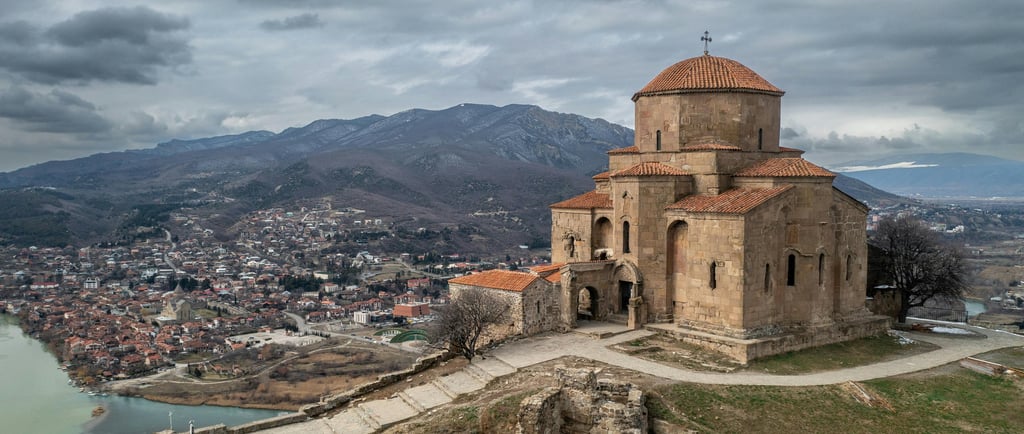
Did you know? Constructed in the late 6th century, Jvari Monastery (seen in image above) is a masterpiece of the specific 'Tetraconch' architectural style, and its unique harmonious geometry, which perfectly balances the dome with the four surrounding apses, served as the direct model for over 200 other churches across Georgia and Armenia, profoundly shaping the entire course of religious architecture in the region.
By choosing these multicultural environments, students become essential conduits for cross-cultural communication. The professional framework at the ASCERT Institute is designed to navigate the complexities of travel advisories and shifting visa policies so that families can maintain their focus on the ultimate goal: producing a competent, global physician. The world remains an open book of learning, and even amidst conflict, the tools for academic triumph are maintained through personalized placement in these stable havens. Comprehensive support is provided, directly engaging with the universities themselves to ensure a simple and transparent admission process. From the application phase through arrival on campus, logistics are managed professionally so that students can focus entirely on their scientific and technical training.
Are You Ready to Invest in Your Future as a Global Healthcare Professional?
The landscape of 2026 may not require wishful thinking as much as taking action. We ask students and families to move beyond the traditional limitations of a localized system. This requires recognizing that the pathway to a prestigious and globally recognized medical career does not depend on a single, high-cost domestic route. The Opportunity Gap is closed through world-class international education. Choosing to study abroad in Georgia, Uzbekistan, or Kyrgyzstan is an investment in human capital and the future. It is a logical, more accessible path to becoming a global healthcare professional.
Are you eligible to study at a premier university in Georgia, Uzbekistan, or Kyrgyzstan? Find out here.
A.S.C.E.R.T. Institute
Visualise. Endeavour. Triumph
Contact
Address
director@ascertinstitute.com
+91 9500 305 996
© 2025. All rights reserved ASCERT INSTITUTE
Dasan Building, Ponkunnam, Kanjirappally,
India, 686 506
My Home, Kukatpally, Hyderabad, Telangana, India, 686 506
638, Bowling Green Drive, Frisco Texas, USA, 75034
+91 9895 739 812
admissions@ascertinstitute.com
+91 9585 356 582